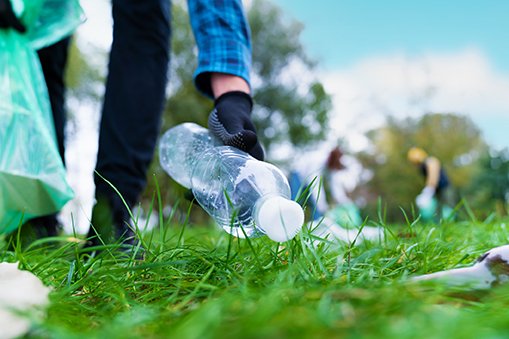
More than 20 million people across over 190 countries are taking part in World Cleanup Day 2026 to tackle plastic waste. But cleaning up alone is not enough – plastic must remain in the circular economy. The key is recognizing the value of the material: shifting the perception of plastic from worthless waste to a sought-after resource for the future. Four international pioneers demonstrate how this transformation can be achieved through their innovative approaches.
Making this vision a reality requires technology, supply chains, policy, and public awareness to work hand in hand. And it all begins with changing the way we think about the material itself.
Vision and awareness
Plastic must evolve from being the end product of a throwaway society into a sustainable raw material within the economy. The technologies needed for recycling and recovery are already well established. Completing the circular economy is now primarily a matter of mindset: only when the material gains social or economic value can established ways of thinking begin to change. This is where the Plastic is Fantastic Association (PiFA), based in Vienna, comes in. Under the motto “Powerful Material. Powerful Voice.”, the association advocates fact-based communication about plastics.
Dominic Fiel, executive director of PiFA, reinforces this vision, “The material itself is not the problem. Problems arise with incorrect use or careless disposal.” The association seeks to drive a cultural shift through open and honest dialogue. According to Fiel, the goal is to “use materials more intelligently, close material loops, and use its advantages responsibly” in order to fundamentally change the discussion.
Turning waste into premium material
In practice, modern recycling technologies are already transforming post-consumer plastic waste into high-quality secondary raw materials. Günther Klammer, CTO of Austrian recycling company Next Generation Recyclingmaschinen (NGR), believes that political action is now essential. “At present, it is not possible to recycle plastic more cost-effectively than producing virgin plastic. Policymakers must create the framework conditions for efficient and economically viable recycling. The technologies already exist.
Because fossil-based virgin plastic remains extremely inexpensive, used plastic is often mistakenly regarded as worthless. “Recycling restores the material’s value,” says Klammer, referring to the impact of modern recycling technologies.
These technological advances must now be scaled up across industry. Sandy Lin, director at Da Fon Environmental Technology in Taiwan and PiFA’s Cluster Manager for Asia, emphasizes that modern recycling goes far beyond producing recycled materials. According to Lin, the priority is “building the data infrastructure and standards that make recycled plastics trustworthy for global brands.” Complete traceability transforms recycled material into a reliable economic resource for international supply chains.
Lin adds, “Plastic itself is not the enemy. Waste and mismanagement are. When we combine smart design, transparent data, and a robust recycling infrastructure, plastic becomes a core pillar of a sustainable future.”
The transformation reaches its full potential at the grassroots level. Where waste management infrastructure is lacking, recycling initiatives can turn plastic waste directly into a means of survival. The Swiss non-profit organization Buy Food with Plastic uses plastic waste as a currency in the fight against hunger and extreme poverty.
CEO Khalil Radi demonstrates every day in Nicaragua, Ghana, and India how professional waste management can improve lives while stimulating local economies. “What many people underestimate is that plastic waste has value. I am one hundred percent convinced that a country’s GDP would grow if it managed and monetized plastic waste professionally.”
By allowing people to pay for meals with collected plastic bottles, the organization creates an immediate economic foundation. Radi is convinced that communities quickly recognize the system as “a reliable source of income.” For him, one message should remain with people above all: “People should remember that plastic waste can create opportunities.”
Against the backdrop of World Cleanup Day, these four pioneers point in the same direction: the solution to the global plastic waste challenge does not lie in bans, but in recognizing plastic as an essential resource that creates value when kept in the circular economy.