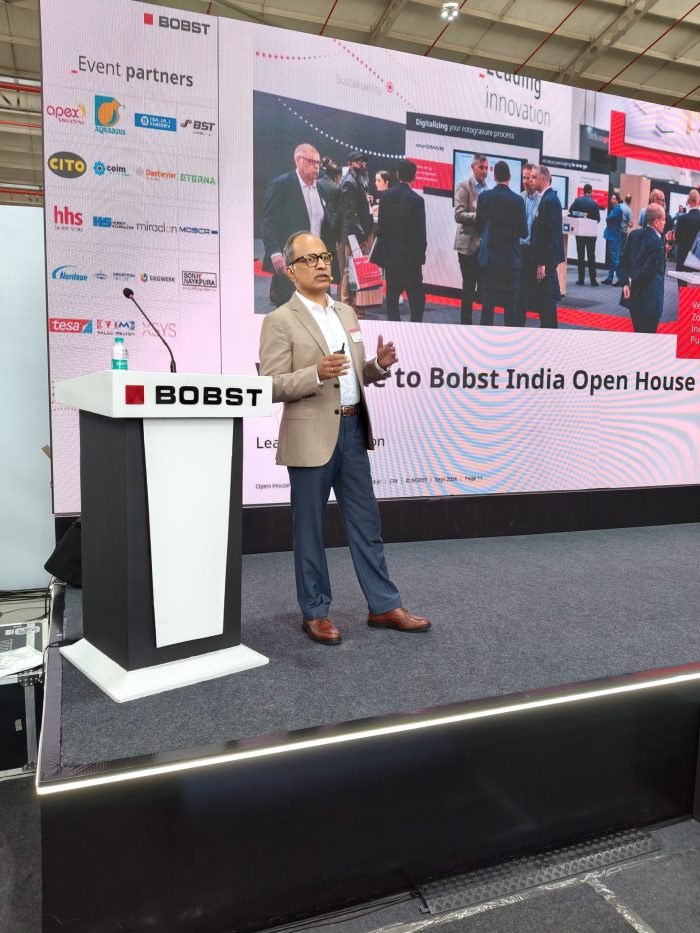
India’s carton market has significant headroom for growth as rising consumption, automation and changing packaging requirements create opportunities for converters and equipment makers, according to Bobst India. Speaking at Bobst’s Pune open house on 9 September, Venugopal Menon, zone business director, folding carton and corrugated board, said India’s per-capita folding carton consumption remains well below that of major packaging markets.
Menon was speaking about folding cartons, litho-laminated cartons and corrugated cartons.

“India is at around 3.7 kilograms per capita, while China is at 14 kilograms and the US is around 19 kilograms,” Menon said, highlighting the visible headroom for growth. According to him, the corrugated packaging market is also expected to expand. Global corrugated volumes are projected to rise from 172 million tons to 185 million tons by 2030, with the market value increasing from about US$ 240 billion to US$ 260 billion.
Menon said India’s recycled liner paper (called Kraft by some) production for corrugation is currently between 7.5 million and 8 million tons, with about 6.5 million tons used for corrugated packaging and the rest for other applications including sacks and bags. The segment could see substantial growth as converters invest in higher productivity and automation.
“Technology is moving from the pilot stage into production,” Menon said, highlighting automation, smart packaging, lightweighting, recycled materials, digital printing and artificial intelligence as major trends affecting the packaging industry.
In corrugated packaging, automation is increasingly used to meet labour requirements, add value such as color printing, and improve productivity, with mega plants adopting robotics, automatic conveying systems, and high-speed machinery. Digital printing is also gaining ground for customized packaging, point-of-sale applications and promotional campaigns.
Folding carton or monocarton converters are simultaneously facing greater pressure to improve sustainability and product functionality. Trends include lightweighting, recycled board, barrier coatings, track-and-trace, anti-counterfeiting and smart packaging.
Menon highlighted the growing importance of the EU’s Packaging and Packaging Waste Regulation (PPWR), particularly for Indian exporters supplying to European markets. The regulation places greater emphasis on packaging waste reduction, recyclability, material use and producer responsibility. In addition, there are regulations concerning the responsible and traceable sourcing of raw materials.
“Margins are becoming tighter,” Menon said. “Converters need cost efficiency, zero faults, less waste and higher productivity.” Bobst is positioning its equipment and technology portfolio around these requirements.