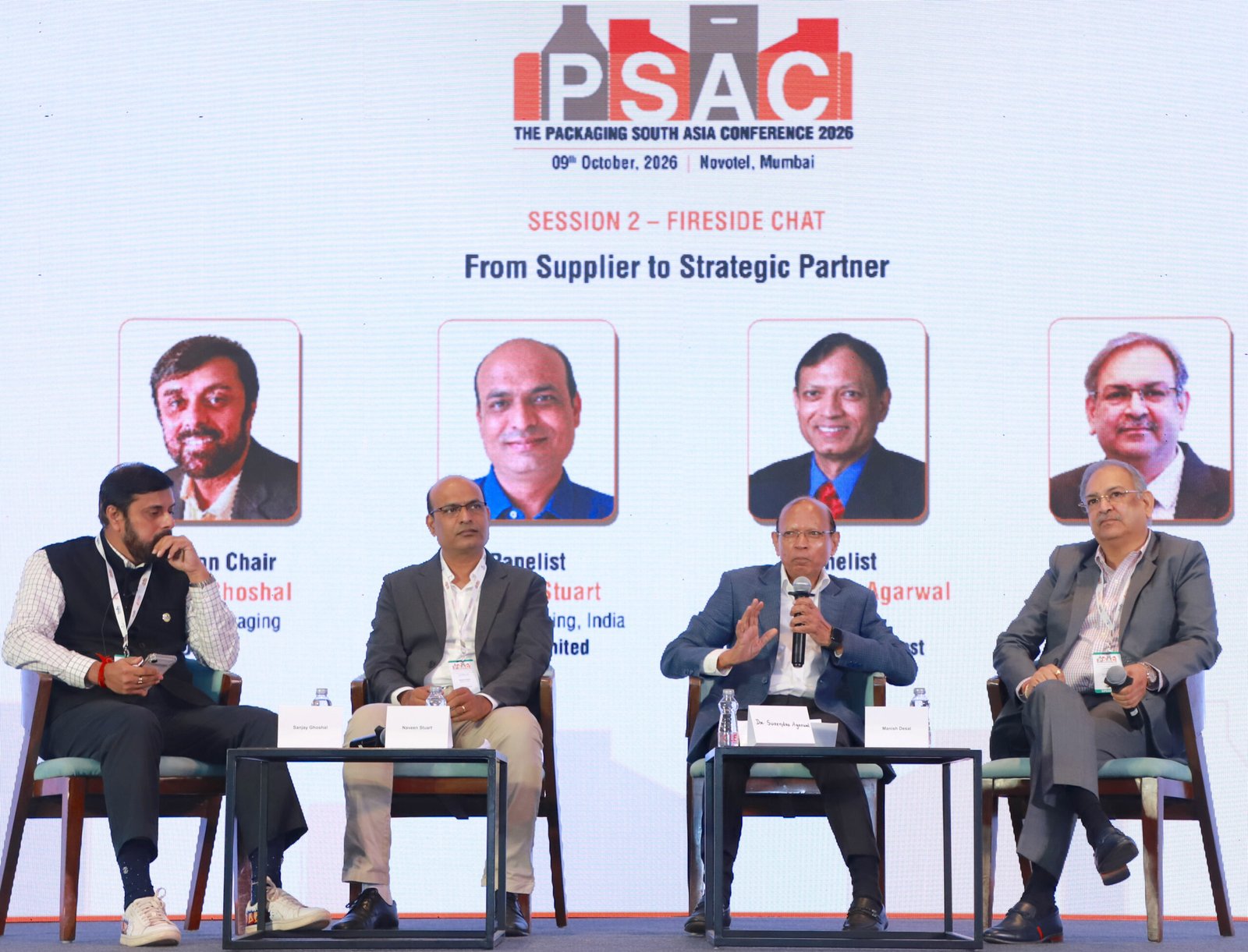
Closer collaboration between packaging suppliers and brand owners is essential to managing raw material price volatility, improving sustainability and building resilient supply chains, industry executives said at the Packaging South Asia Conference (PSAC) 2026 in Mumbai on October 9.
At the fireside chat session titled From Supplier to Strategic Partner, panelists discussed how suppliers could move beyond fulfilling orders to become strategic partners involved in product design, material selection and packaging development. Sanjay Ghosal, head of packaging at Diageo, chaired the session, with Naveen Stuart, head of packaging development at Marico; Dr. Surendra Agarwal, founder of Creative Technologies; and Manish Desai, director of Mudrika Labels, participating.
Against a backdrop of continued volatility in polymer prices and other rising costs that have pressured packaging manufacturers and their customers, the panelists said maintaining supplies while preserving profitability across the value chain was critical to a resilient economy and packaging industry.
Resin accounts for more than 90% of the cost of rigid packaging in some applications, explained Agarwal, leaving manufacturers limited control over production costs when polymer prices rose. The priority, he said, was to maintain uninterrupted supplies so brand owners could keep production running and protect market share. “If we don’t supply the package to our brand owners, they cannot fill the shelf space, and they will start losing their market share.”
He added that suppliers and brand owners needed to work together to ensure both sides remained profitable. “If anybody in the supply chain doesn’t make a profit, he’s not going to last very long,” he said, emphasizing the importance of working with customers as strategic partners rather than simply as suppliers.
Agarwal said Creative Technologies had established an expert panel to monitor developments in raw material markets and supply chains. The team prepares regular briefings for brand customers on material costs, availability, potential shortages and alternative polymers that could be used if particular grades became difficult to source.
He also highlighted lightweighting as a way to reduce the impact of rising material costs. “If we use less material, we are going to have less impact of the cost increase.”
Desai said Mudrika Labels had increased its raw material inventory to maintain steady supplies amid price volatility, cautioning that even a relatively small packaging component could halt production if it became unavailable, making supply continuity essential. “Mudrika’s role extends beyond supplying labels to providing solutions tailored to customers’ production requirements. Changes in raw materials can require adjustments to label specifications, adhesives and release liners to ensure packaging continues to run smoothly on production lines.”
Design and material choices
The panel examined how packaging design and material selection could balance cost, functionality and environmental considerations as plastics use continues to grow. Marico’s Stuart suggested the industry needed to address rising plastic consumption, alongside the effort to reduce its environmental impact. Asserting that brand owner and supplier collaboration should begin at the design stage, packaging could be optimized rather than adding material simply to create a premium appearance.
“Nobody says that I have to increase the packaging component to make it premium,” Stuart said, pointing to opportunities to improve appearance and functionality without unnecessarily increasing material use.
Agarwal argued that the packaging industry needed to do more to explain the functional benefits of plastics, including their low weight, affordability, and versatility. “The best thing we can do as an industry is educate the people on the benefits of plastics,” he said. Favoring plastic closures for plastic containers, he added that matching materials could simplify recycling by reducing the need to separate metal closures from bottles and jars.
Desai highlighted the challenges of recycling multilayer flexible packaging, cautioning that reducing material use did not automatically make a package easier to recycle. He said the industry needed to educate consumers about both the benefits of plastics and proper recycling practices.
The panelists agreed that no single material or decoration technology would suit every product. Choices between plastic and metal, rigid and flexible formats, or different labeling and printing methods would depend on product specifications, consumer expectations, cost and sustainability requirements.
Choosing the right decoration technology
Desai outlined available options for brands, including self-adhesive labels, cut labels, shrink sleeves, heat-transfer films, direct printing and in-mold labeling (IML). He said suppliers should recommend technologies according to product requirements rather than offering a single solution.
He cited the adoption of IML in ice cream packaging as an example of how decoration technology had evolved, enabling more elaborate designs and reliable performance under deep-freeze conditions. He also identified IML and heat-transfer films as potential sustainable options for suitable products, while explaining their suitability depends on the container material, application and expected product life.
Stuart said the choice between direct printing and labeling also depended on a product’s market positioning and the price consumers were willing to pay. “There is no right or wrong decision there. It all depends on product to product and what your business strategy is all about,” he said.
He cited Marico’s Parachute Blue bottle as an example of a mass-market product using direct printing to keep packaging costs low. Other products in the company’s portfolio use more elaborate packaging to reflect their positioning and consumer expectations.
Collaboration from concept to commercialization
Looking ahead, the panelists agreed suppliers should be involved from the earliest stages of product development rather than brought in only after packaging specifications had been finalized. Agarwal said early engagement could help manufacturers optimize packaging dimensions, improve material efficiency and reduce wall thickness where appropriate. Even minor design changes, such as adjusting a bottle’s diameter by 1 to 2 mm, could improve production efficiency by allowing more cavities in a mold. “Working with the brand owners as a strategic partner from the concept to commercialization is the key to success.”
Desai similarly urged brand owners to consult packaging and decoration specialists before finalizing designs, noting that some products developed without their input could prove difficult to reproduce using the intended printing or decoration process.
Stuart said suppliers should also be encouraged to question brand owners’ specifications and suggest alternatives. “They should also question our specifications,” he said, arguing that two-way communication could lead to better-optimized solutions than simply manufacturing packaging to an existing brief.
Concluding the discussion, Ghosal said collaboration and co-creation were fundamental to building resilient supply chains. “Packaging decisions ultimately needed to serve the consumer while creating value for suppliers, brand owners and trade partners across the value chain.”