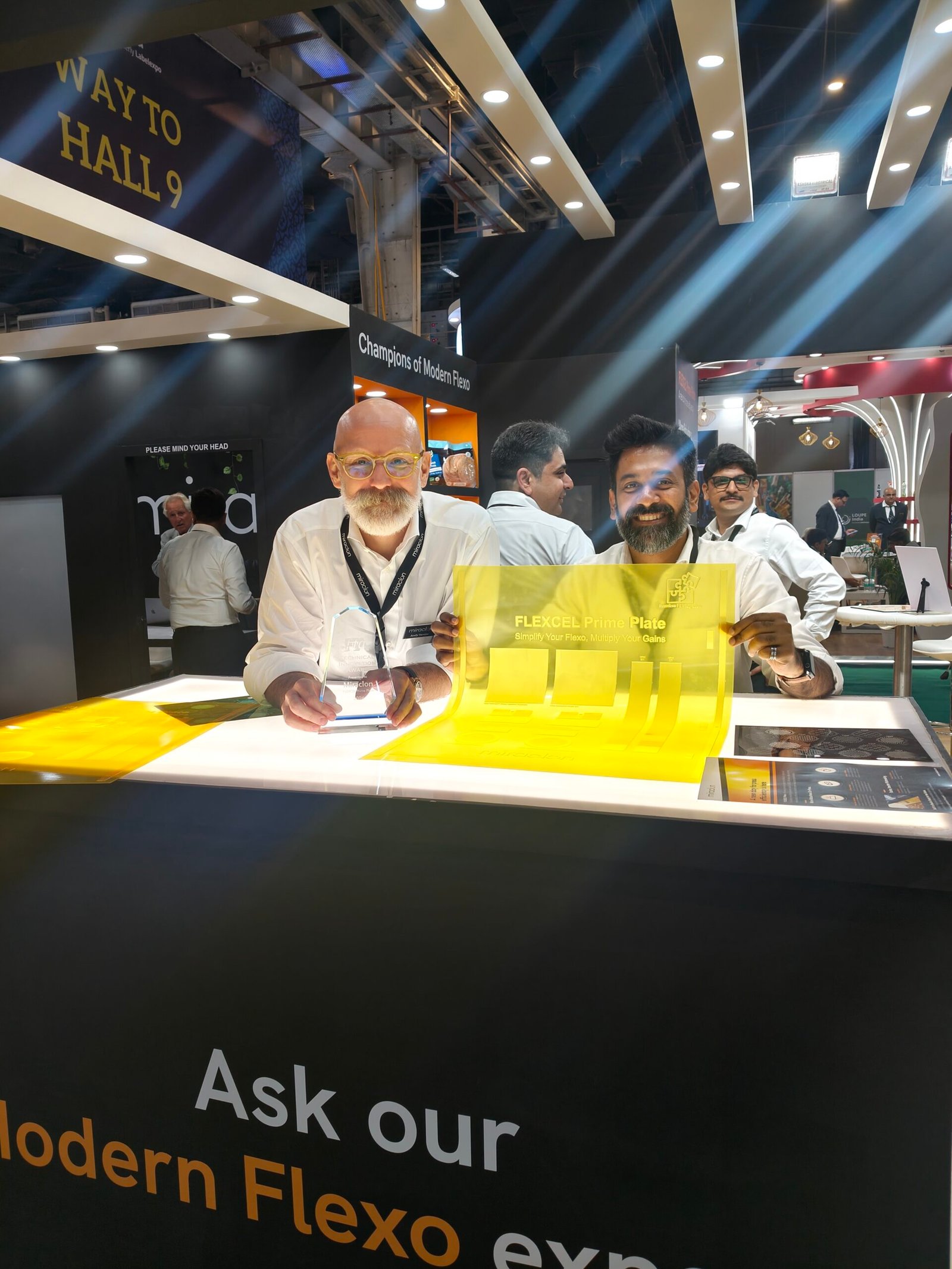
Miraclon is stepping up its focus on India’s flexible packaging market, combining the introduction of its Flexcel Prime Plate with a broader push to help printers and converters adopt modern flexo practices. The company sees India as one of its fastest-growing markets globally, supported by investments in central impression (CI) flexographic presses, rising demand for flexible packaging and the expansion of consumer markets.
Speaking to Packaging South Asia at Loupe India 2026 in Greater Noida, Andy Yarrow and Hersh Lulla of Miraclon outlined the company’s strategy to build on its established Flexcel NX Technology, improve pressroom efficiency and develop technical capabilities across the Indian flexographic printing industry.
The introduction of the Flexcel Prime Plate in India is a key part of this effort. The new plate builds on the established Flexcel NX platform, with additional features designed to improve press performance and simplify job handling.
“We stopped talking about quality several years ago. The quality of NX is incredibly high and customers like it, but what we focus on, particularly when talking to printers and converters, is the on-press benefits,” Yarrow said.
These benefits include faster press start-ups, fewer stoppages and the ability to implement expanded color gamut (ECG) printing through the plate’s ink-transfer capabilities. The Flexcel Prime Plate adds Stay-Clean Properties, which help reduce ink build-up and the frequency of press stops for plate cleaning, enabling longer uninterrupted runs.
The plate features a lift-resist formulation, designed to improve plate handling and make mounting and remounting easier, supporting plate reuse. Its seamless fit printing approach is intended to allow customers to introduce the new plate into existing Flexcel NX production conditions without major workflow changes or the need to reprofile established processes.
Modern flexo moves beyond print quality
Miraclon’s Modern Flexo initiative, which has been central to its messaging since last drupa, focuses on the production and operational advantages of flexographic printing rather than treating print quality as the sole measure of performance.
The approach focuses on process standardization, controlled workflows and closer collaboration among printers, converters and pre-press partners. The objective is to reduce make-ready times, improve consistency and increase the number of jobs that can be completed during a production shift.
Yarrow said the Indian market had seen a substantial influx of new CI presses, particularly from European manufacturers. However, investing in equipment alone does not guarantee that converters will achieve their full potential.
“What we’re talking to people about more and more is that if they allow us to help them standardise as much as possible, it gives them a great platform to build their flexo business,” he said.
Miraclon’s optimized flexible packaging (OFP) program applies these principles in collaboration with customers.
The program’s potential impact is particularly visible in make-ready times. Yarrow said while two to three hours was still common in some pressrooms across the region, participating customers following modern flexo practices had achieved make-ready times of around 20 minutes.
Such reductions can help converters increase throughput, improve equipment utilisation and accommodate more jobs without adding production capacity.
Overcoming the gravure mindset
Lulla said the transition to modern flexo presents a particular challenge in India because much of the flexible packaging industry has traditionally relied on gravure printing.
Converters investing in CI flexo presses often bring their existing gravure workflows and assumptions into the new process. However, the two technologies operate differently, and applying gravure-based production parameters to flexo can limit the benefits of the investment.
“The biggest challenge is getting people who are investing in CI flexo presses, many of whom come from gravure, to shift their approach,” Lulla said.
This challenge, he said, also creates an opportunity. India’s competitive market and the willingness of converters to invest in new equipment have encouraged several businesses to adopt the procedures and protocols associated with modern flexo.
Lulla emphasized that the transition does not require every converter to implement every element of the program immediately. The appropriate level of adoption depends on the customer’s commitment, the types of jobs it handles and the requirements of its clientele.
The goal is to help printers progress from traditional flexographic practices towards a more standardised production model, while involving trade shops and pre-press providers as value-added partners.
India’s growth prospects
Yarrow described India as one of Miraclon’s strongest growth markets, saying the company had experienced significant expansion since he joined the business. He expects investment in flexographic printing to continue, although the pace may moderate from recent levels.
He pointed to the scale and diversity of the Indian market, including the growth of smaller and regional consumer brands. Such businesses can generate demand for a wider variety of packaging formats and production runs, creating opportunities for flexographic printers.
Another trend is the construction of dedicated press halls rather than the installation of individual machines. Yarrow said he had seen facilities being developed to accommodate three, four, five or even ten presses, reflecting the scale of investment taking place.
He expects gravure, flexo and digital printing to coexist, with converters selecting processes according to job requirements while seeking visual consistency across packaging on retail shelves.
Building capabilities across the industry
Miraclon plans to increase its investment in India over the next two years, including expanding its sales and technical teams. Yarrow said the company had recently added a third salesperson and recruited additional technical personnel, with another technical team member expected to join early next year.
Lulla said the company also wanted to address gaps in technical knowledge across the industry. Alongside direct customer support, Miraclon intends to work with suppliers and educational institutions to improve understanding of modern flexo practices.
The initiative is aimed at building skills at the grassroots level, so that the growing installed base of flexographic presses can be operated efficiently by appropriately trained personnel.