This year’s Interpack has been rather calm, in particular at the six halls dedicated to packaging production, basically covering printing, marking and labelling systems, thermoformed containers, and packaging materials. Most of the traffic over the seven exhibition days took place in the twelve other halls, covering filling and packaging process equipment.
Increasingly, the exhibitor and attendance numbers appear to be contradictory. The total number of exhibitors has been more or less stable over the past two decades, but only due to the rise in numbers from Asia, Turkey, and South America, whereas the number of visitors from those parts of the world has been declining as much as from Europe, except perhaps from Eastern Europe.
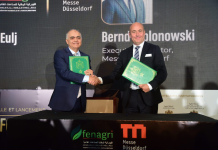
It beomes more and more clear, over the past few decades, that the European megashows are having difficulty keeping up their numbers, due to the development of other regional and more localised trade fairs, in particular in emerging economies. Messe Düsseldorf’s Interpack actually attempted to align itself with this trend by creating the Interpack Alliance with trade fairs in China, India, Saudi Arabia, Egypt, Algeria, Thailand, the Philippines, as well as the strategic partnership with North-American PMMI signed a few days ago.
For printers and packaging converters, Drupa and Interpack were long been considered something like twins. In the glory days of the megashows, they used to be held at an interval of one month only, until the overlaps between the two eroded their viability for both visitors and exhibitors. For Drupa and its main clientele, packaging printing and converting became a major highlight as one of the segments with the highest growth perspectives for printers.
For manufacturers in this segment, Interpack remained relevant for the interface with the subsequent filling and packaging processes, but attending both shows (in terms of costs and time) only made sense for the enterprises directly in both business segments. In 2017, Messe Düsseldorf’s senior management together with major industry players decided to reposition the two shows, focusing Interpack on actual processing and packaging machinery, while keeping most of the packaging printing and converting equipment at Drupa.
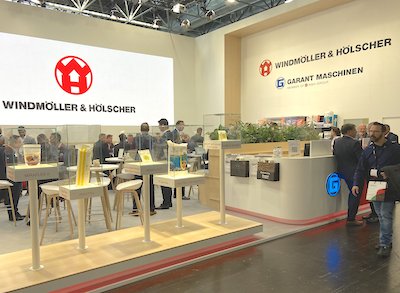
The ensuing results are even more obvious this time than at the previous Interpack in 2023. Whereas more than two-thirds of the 2,700 exhibitors brought filling, packaging, and processing solutions to the show, hardly one-third consisted of manufacturers of equipment and materials for the actual production of packaging. And most of these, although hiring large booths, had no running machinery on show. With the exception of ABG, Screen, Vinsak, and Windmöller & Hölscher, the printing and converting equipment manufacturers present at Interpack limited their presentations to marking and labelling solutions. While none of these had running machines at their stands, but W&H organised Open House events at its Lengerich headquarters about 80 minutes away.
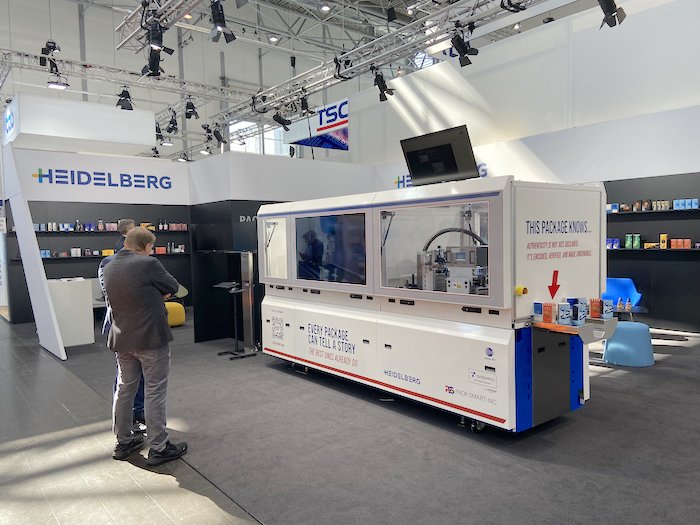
Heidelberg, presenting itself as a system integrator for packaging, demonstrated a digital marking system for product authentication developed in a collaboration with Pack-Smart and Metsä, both also present with their own booths at Interpack. While focusing on processes upstream and downstream of printing at this show, Heidelberg CEO Jürgen Otto emphasized, “Technological enhancements to the portfolio and the expansion of regional activities in growth regions such as Latin America and India will also be further advanced.”
Koenig & Bauer limited its presentations to labelling and marking as well, with a range of SPA laser and hpdSYSTEM coding equipment, 4PL labelling systems, betaJET DOD inkjet printers, and ttPRINT thermal transfer printers. Marking and coding equipment was also presented by Atlantic Zeiser, Domino, Epson, GEA, Hitachi, HP, Konica Minolta, Markem-Imaje, OKI, Ricoh, Screen and Videojet, among others.
IMA Industria Macchine from Italy, which had the entire Hall 17 again took the largest space at Interpack, and showcased several marking and coding systems in addition to its processing equipment. Vinsak was one of the few companies focusing on a range of packaging printing and converting equipment, albeit from a small booth without running machinery this time. Michelman presented a paper-based packaging concept developed with Bobst and UPM, combining its bio-based coating experience on fiber-based materials.
Probably the most interesting part in the packaging production segment were the material technologies on show, led by various mono-film innovations and fiber-based materials and containers determined by the drive toward renewable and recyclable packaging.
Taghleef Industries presented a range of bio-based, recycled mono PP and material-reduction solutions for flexible packaging and labels. Jindal also showcased high-barrier mono PP materials developed with Wolf Packaging that are entirely recyclable, emphasising the increasing application of polypropylene for thermoforming and FFS packaging. Illig Packaging Solutions, a manufacturer of thermoforming machinery, presented a pilot with food containers made of dry natural fiber. Dry molded fiber solutions were also shown by Optima and a number of Chinese, South Korean, and Indian companies. Sappi centered its presentations around high-barrier papers for flexible packaging. Paper- and cardboard-based packaging materials could also be found at the booths of Koehler, Metsä, Stora Enso, UPM, and a cluster of Chinese companies.
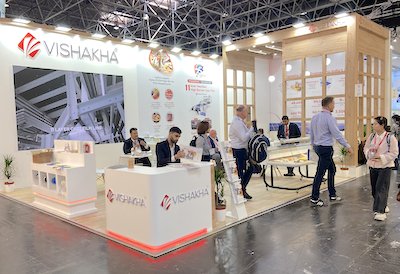
Vishakha Polyfab from Ahmedabad showcased its range of high-barrier multilayer films, including PCR/PIR based formulated film, vacuum-formable film, bio-based PE polymers, water quenched co-extruded barrier films, multilayer tray-lidding films, FFS and lamination films.
Sumilon from Surat, Gujarat, presented its full range of BOPET, heat-sealable PET and high-barrier polyester films. Close to one hundred material suppliers from India, including Brilliant Polymers, Megaplast, Multitech, SRF, Vacmet and so many others, attended the fair again this year. Almost half of these clustered together in the largest ever India Pavilion at Interpack.
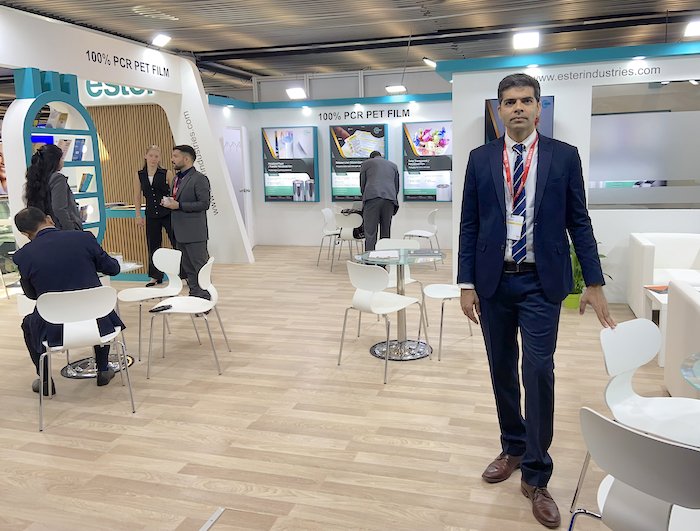
Ester Industries, a biaxial film manufacturer established more than 40 years ago and based in Gurgaon, came to Interpack with a completely new and recyclable Ultra Heat Seal film development, sealing faster and holding stronger within the packaging line. The film enables mono-material packaging design, largely replacing PE and complex laminates. Available in transparent and metallized versions, it has high barrier properties, thus enhancing product protection and shelf life.
For the first time with a large booth at Interpack, the company with operations across six continents and more than 550 employees also showcased its complete range of other polyester films, including high friction, sealable, medium and high barrier films as well as heat seal, matte and white opaque films, metallized paper, transfer metallized films, PVDC coated films, thermoformable films, holographic metallized films, and release liners. Ester also produces specialty polymers and recycled PET.
Among the exhibitors at this year’s Interpack, 445 made it from China and Hong Kong, as compared to the other three largest contingents: 534 from Germany, 402 from Italy, and 287 from Turkey. In total, 735 companies from Asia-Pacific were present at Interpack 2026, including 113 from India, 52 from South Korea, 50 from Taiwan, 30 from Japan, 12 from Malaysia, 10 from Singapore, 7 from Vietnam, and 16 from Indonesia, Thailand, Pakistan, the Philippines, and Australia. Exhibitors in the Packaging & Processing part of the show could be divided over the following segments: food 445, pharma 324, confectionery 324, industrial 304, bakery 302, cosmetics 294, and beverages 269.
The next Interpack at Messe Düsseldorf has been planned for May 2029.